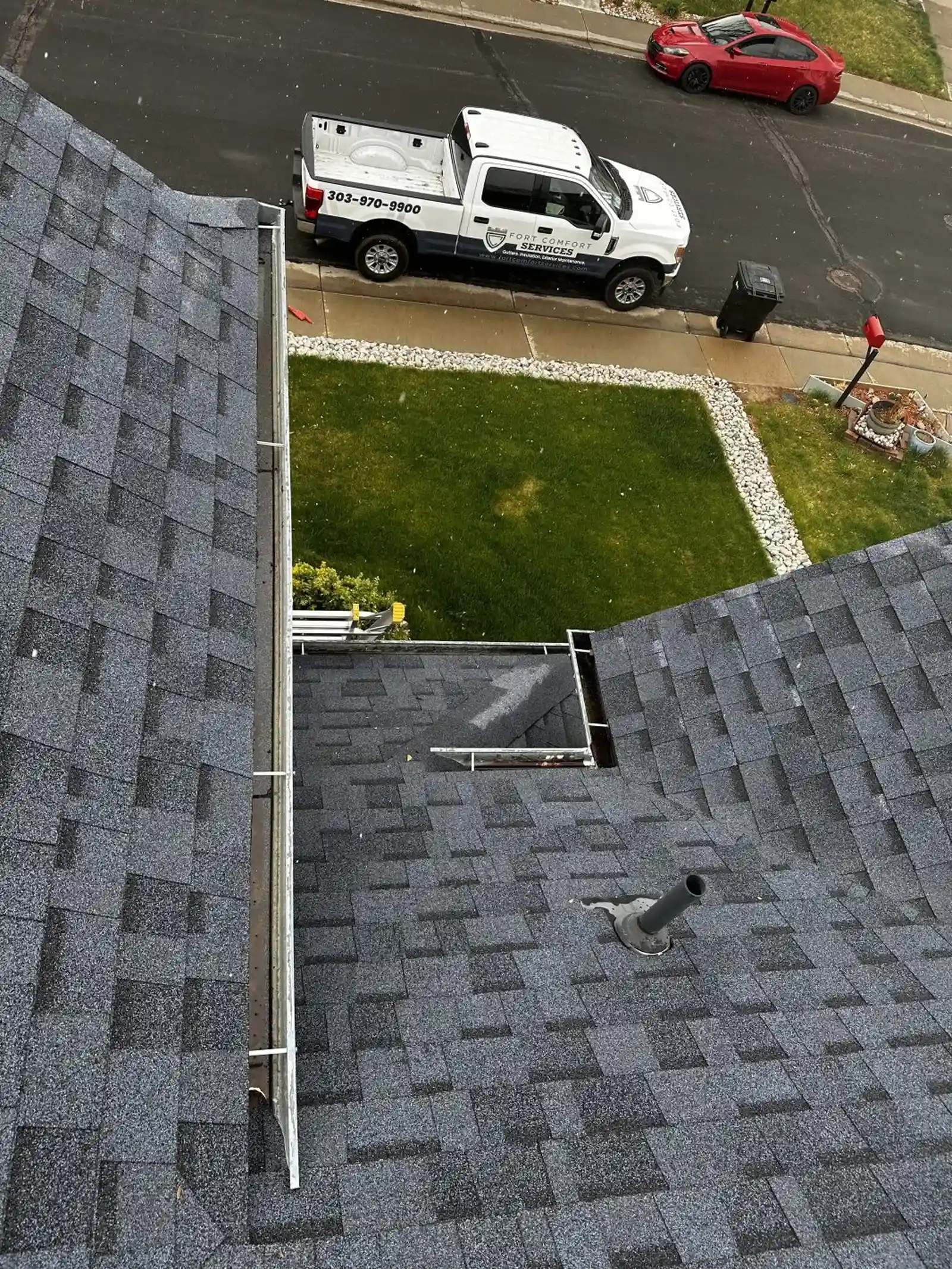
Most Lakewood homeowners pay $200 to $350 for a professional gutter cleaning. The price is set by your home's size, roof pitch, and roof elevation, and you get it as one flat number. A twice-a-year plan runs $360 to $630 a year and saves 10 percent. Three cleanings a year runs $480 to $840 a year and saves 20 percent. The number we give you is the number on the invoice.
That's the answer. The rest of this guide covers how our gutter cleaning pricing works, how to check the plan math yourself, where Lakewood's ranches, split-levels, and two-stories tend to land, and why foothills snow changes the cleaning calendar here. It also covers what a complete cleaning includes and when a cleaning isn't the fix. The same pricing applies in Lakewood, next door in Wheat Ridge, and up the road in Golden.
Lakewood gutter cleaning prices
| Home size | 1 cleaning a year | 2 cleanings a year (save 10%) | 3 cleanings a year (save 20%) |
|---|---|---|---|
| Small home or townhome | $200 | $360 a year | $480 a year |
| Medium house | $250 | $450 a year | $600 a year |
| Large house | $300 | $540 a year | $720 a year |
| XL or complex roof | $350 | $630 a year | $840 a year |
Lakewood is not priced differently from Denver, Boulder, or anywhere else we work. Same tiers, same plans.
How the price is set
Three things decide your number: home size, roof pitch, and roof elevation. That's it.
You answer a few quick questions about your home in our instant quote tool and get a price in about 60 seconds. No visit is needed. We confirm the details and schedule. The price you're quoted is what shows up on the invoice. Nobody measures on arrival and nobody revises the total.
We price this way because the alternative leaves you guessing. A quote that depends on linear footage, story count, or "how bad it looks when we get there" isn't a price. It's a formula you can't finish yourself. Most homeowners don't know their gutter footage, so a per-foot quote turns into a number you only learn after the crew is on your roof.
Why "it depends" is an incomplete answer
Ask around and you'll hear that gutter cleaning "depends on the house." True, but not useful on its own. What it depends on matters.
Square footage alone doesn't predict cost. Roofline does. A 1960s Lakewood ranch with one long gable roof has simple, reachable runs. A 1970s split-level of similar size can have three roof heights, extra corners, and runs that sit over a lower roof section where ladders can't go straight up. That's more setup, more repositioning, and more time for the same square footage.
That's why our tiers account for pitch and elevation, not just size. The tier reflects what it actually takes to clean your roofline safely.
Check the math on a plan
Plan pricing follows a simple rule. Two cleanings cost twice the single rate minus 10 percent. Three cleanings cost three times the single rate minus 20 percent. Here's how that works out for two common tiers:
| Tier | Single cleaning | 2 visits at full price | 2x plan (minus 10%) | 3 visits at full price | 3x plan (minus 20%) |
|---|---|---|---|---|---|
| Medium house | $250 | $500 | $450 | $750 | $600 |
| Large house | $300 | $600 | $540 | $900 | $720 |
On a medium house, the 3x plan works out to $200 a visit, the same as a single small-home cleaning.
Plans also come with perks beyond the discount:
| Plan perk | 1x | 2x | 3x |
|---|---|---|---|
| Full debris removal and disposal | Yes | Yes | Yes |
| Before and after photos | Yes | Yes | Yes |
| Priority booking in peak season | No | Yes | Yes |
| Discount on non-cleaning gutter services | No | 10% | 20% |
| Complimentary gutter corner sealing | No | No | Yes |
Where Lakewood homes tend to land
Lakewood is Jefferson County's largest city, and its housing stock is about as mixed as the metro gets. From Green Mountain to Bear Creek you'll find mid-century ranches, 1970s split-levels, 1980s two-stories, and newer builds.
Single-story ranches. Simple rooflines and low eaves. These usually sit toward the lower end for their size.
Split-levels. Multiple roof heights and more corners. These often land a step higher than the square footage suggests, because elevation and access drive time.
1980s two-stories. Taller ladder setups and more repositioning. Pitch and height push these up the range.
Hillside lots. Homes built into slopes, common on the Green Mountain side, can have one side that's a full story taller than the other. Elevation is part of the price for that reason.
The instant quote sorts this out for your specific home. You don't need to guess your tier.
Lakewood's debris year
National advice assumes one fall cleaning. That doesn't fit the Front Range, and Lakewood sees a heavier version of the metro pattern.
| Season | What lands in the gutter | What it means for you |
|---|---|---|
| Winter into March | Bark, seed pods, and roof grit washed down by heavy wet snow and freeze-thaw | A gritty layer settles at the bottom of the trough |
| May | Cottonwood fluff | Mats into a dense layer when wet. Clean after the drop, not before |
| May through August | Shingle granules and debris knocked loose by hail | Heavy grit packs into sludge that rain won't clear |
| Year-round | Pine needles | Weave into mats that trap everything else |
| October into November | Leaf drop from mature canopy | Clear before the first hard freeze |
The mature trees across Lakewood's established neighborhoods are why most homes here need two to three cleanings a year. Wait for full leaf drop before your fall cleaning. A cleaning done while half the leaves are still up means doing it again.
Foothills snow and the fall cleaning that matters most
Lakewood sits closer to the foothills than Denver and gets more snow because of it. That changes the stakes of a clogged gutter.
A gutter that goes into winter full holds water. That water freezes, adds weight, and pulls on hangers that are already carrying a heavier snow load than plains homes see. Standing ice in the trough also feeds ice dams, which push meltwater back under the roofline and behind the fascia board.
So in Lakewood, the late fall cleaning is the one not to skip. If you book only one cleaning a year, make it the one after the leaves are down and before the ground freezes.
We work year-round, but ice limits what can be reached safely from a ladder. If your gutters are already iced over, call and we'll tell you honestly whether it's a now job or a wait-for-a-thaw job.
How often to clean gutters in Lakewood
| Your lot | Recommended | Timing |
|---|---|---|
| Open lot, light tree cover | 2x a year | Late spring after cottonwood, fall after full leaf drop |
| Mature deciduous canopy | 2x to 3x a year | Add a visit if leaves keep falling into December |
| Pine, spruce, or cottonwood near the house | 3x a year | Continuous shedding outpaces a 2-visit schedule |
| Trees on multiple sides, or foothills-edge lots | 3x a year or more | Heavier debris and earlier snow |
Staying on schedule is also easier on the system. Packed, wet, frozen debris takes longer to clear and is harder on hangers than a gutter cleaned four months ago.
Get Your Price in Minutes, No Visit Required
Answer a few quick questions about your home and get an instant price. No in-person visit needed.
What a complete cleaning includes
Our standard service is a dry cleaning. Every standard cleaning includes:
- Hand removal of leaves, needles, and packed debris from the full gutter run
- Downspout clearing to remove blockages
- A slope test to confirm water flows toward the downspouts
- A visual inspection for hail damage, cracks, rust, and wear
- Before and after photos
- Full cleanup, with debris bagged and hauled off your property
Wet cleaning is a separate method. It adds a light pressure wash to flush out compacted sediment, staining, and buildup that hand removal can't reach. We'll recommend the right approach for your gutters when we scope your job.
The inspection is the part that pays for itself. A crew working every corner of your roof is in the best position anyone will be in all year to spot a loose hanger, a leaking seam, or soft fascia. If we see something, we stop and tell you, with an honest read on whether it's "keep an eye on it" or "deal with this soon."
Questions to ask any company before you book
These apply to any quote, ours included.
- Is the price fixed before the crew arrives? If the answer involves measuring on site, the number can move.
- Are the downspouts cleared, or just looked at? A clean trough draining into a blocked downspout still overflows.
- Where does the debris go? Bagged and hauled, bagged and left at the curb, or blown into your landscaping are three different jobs.
- Is height or roof pitch already in the quote? If nobody asked about your roof before quoting, expect an add-on later.
- What happens if you're not happy? With us, you call. We come back out and make it right, or comp your next cleaning.
Signs you need a cleaning, no ladder required
- Water spilling over the gutter edge during rain
- Seedlings or weeds growing in the trough
- Sagging runs or gutters pulling away from the fascia
- Streaks or mildew on siding below the gutter line
- Water pooling near the foundation after storms
- Icicles forming along the gutter in winter, a sign water is sitting in the trough
Slow drainage usually shows up first. If water takes longer to clear after a storm than it used to, the gutter is already partly blocked.
DIY or hire it out
On a single-story ranch with level ground and a sturdy ladder, cleaning your own gutters is a reasonable job. Plan on a few hours and a mess.
Lakewood's split-levels and two-stories change that. Reaching sideways from a ladder is how ladders slide, and staggered rooflines mean setting up over lower roofs or landscaping. Past one story, the savings rarely justify the risk.
The other gap is what gets noticed. A homeowner cleaning gutters is looking at leaves. A trained crew is also looking at hangers, seams, pitch, and fascia. On Lakewood's aging 1960s to 1980s systems, that second look often matters more than the cleaning.
What skipping it costs
Overflowing water goes down the fascia and to the foundation. Lakewood sits on the same expansive clay soils as the rest of the metro, which swell when wet and shrink when dry. Repeated saturation at the base of the house is how foundations move.
| What you're paying for | Published range |
|---|---|
| Gutter cleaning, one visit | $200 to $350 |
| Gutter repair, any repair, scoped as one flat price | $100 to $900 |
| Wood or composite soffit and fascia replacement | $20 to $35 per linear foot |
| Typical full gutter replacement | $2,500 to $3,500 |
There's a warranty angle too. Our workmanship warranty on installations and repairs doesn't cover damage from lack of maintenance, including clogged gutters. Keeping gutters clean protects the work you've already paid for.
When a cleaning isn't the answer
We'll tell you when a cleaning won't solve your problem.
The gutters are failing. Many Lakewood homes still have original aluminum systems that are 40 to 60 years old. If seams leak, hangers are corroded, or runs sag back after being reattached, the system needs gutter repair or replacement. A clean gutter that leaks is still a leaking gutter.
The fascia is soft. Gutters that won't stay attached usually mean the board behind them can't hold a fastener. That's soffit and fascia work, not a cleaning.
You're under heavy pines and cleaning three times a year. Fine stainless steel mesh guards may be the better long-term spend. Guards reduce cleaning frequency, but they don't eliminate it. See what gutter guards cost and which ones work here.
Water pools at the foundation even with clean gutters. That's usually a downspout that dumps too close to the house. Extending or rerouting it is often a simpler fix than people expect.
Why Lakewood homeowners book with us
Two things set our cleanings apart.
The number we give you is the number on the invoice. You get a flat price from the instant quote before anyone climbs a ladder. No measuring on arrival, no line items you didn't agree to.
Crews inspect while they're up there. Every cleaning is also a roofline check. You get photos, an honest read on anything we find, and no upsell pressure. On a city full of aging gutter systems, that inspection is often the most valuable part of the visit.
We answer the phone, we show up when we say we will, and if something isn't right, one call gets it fixed.