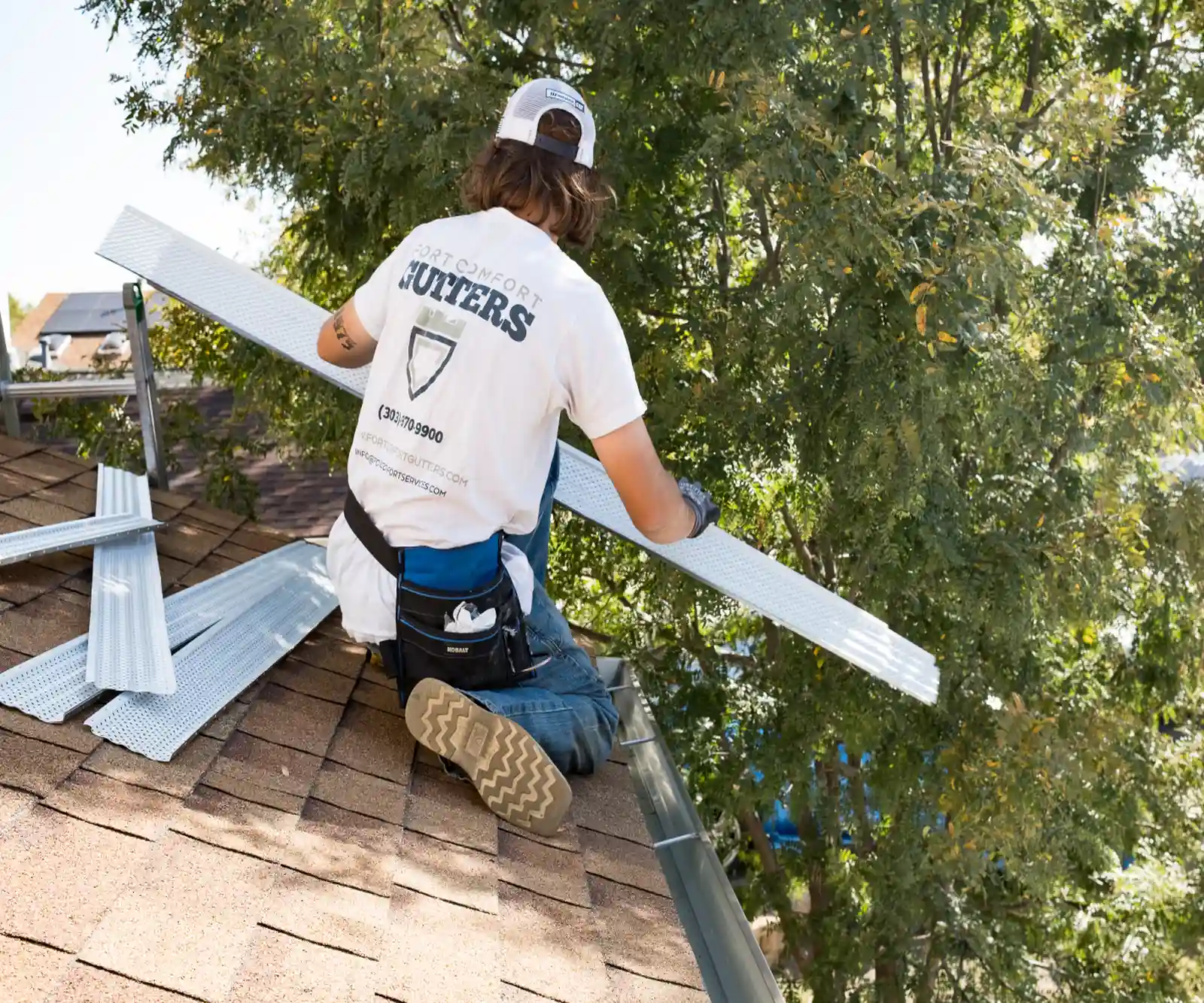
Gutter guards are one of the most oversold products in home improvement. The pitch is always some version of "install once, never clean your gutters again," and that claim isn't true of any guard on the market.
What good guards actually do is worth real money: they stop the large clogs that cause overflow, they cut cleaning frequency substantially, and they keep water moving during the storms when a blocked gutter does damage. That's a genuine value proposition. It just isn't the one in the advertising.
The other thing worth saying up front: the product isn't the gimmick. The one-size-fits-all sales pitch is. The right guard for a home surrounded by ponderosa pine is not the right guard for a home under maples, and a contractor who only carries one system will fit it to every house whether it belongs there or not.
Here's what each system costs in the Denver area, what it does against the debris we actually have, and where each one falls short. It reflects how we approach gutter guard installation across Denver, Aurora, Lakewood, and the surrounding metro.
What gutter guards cost in Denver
Guards are priced per linear foot, installed. A typical Denver home has 150 to 250 linear feet of gutter.
Those are installed prices with a fixed quote before work begins. Which one belongs on your house depends less on your budget than on what's growing above your roof.
Get a Guard Recommendation for Your Actual Property
We don't sell one system to every house. Tell us about your home and we'll match the guard to your trees — with a fixed price before any work begins.
The three systems we install
Soft mesh — the budget option
Flexible mesh panels, available in white, bronze, and grey so they blend with the trim.
This is the entry point, and on the right house it's genuinely adequate. If you're under broadleaf trees — maple, ash, elm, oak — with no conifers nearby, soft mesh blocks the leaves and twigs that cause the clogs you actually get, at the lowest cost per foot of anything we install.
Its limits are real, though. Soft mesh is the least rigid system, which means it's the most likely to deform under snow load or hail, and the openings aren't fine enough to stop pine needles or the granule grit that comes off a roof after a hailstorm. It's the shortest-lived of the three.
Right for: deciduous-only lots, budget-driven projects, rental and investment properties where the goal is preventing the catastrophic clog rather than eliminating maintenance.
Rigid aluminum — Bulldog and RX systems
Heavy-duty rigid aluminum. For a large share of Denver metro homes, this is the best value on the board.
The rigidity is the point. Aluminum holds its shape under snow load and shrugs off hail that would crack or deform lighter systems — which matters more here than almost anywhere, since the Front Range sits in one of the most hail-exposed corridors in the country. It handles high-volume runoff without the overflow problems that some solid-cover designs have during the short, intense downpours typical of a Colorado summer storm. And it lasts.
Depending on your tree coverage, this is frequently the best option for a house outright, not a compromise between the cheap tier and the expensive one. If you have moderate deciduous cover and no significant conifers, spending up to fine stainless buys you protection against a debris type you don't have. It also pairs naturally with a fresh gutter installation when the old runs are past saving.
Right for: most Denver metro homes. Moderate to heavy deciduous debris, hail exposure, snow load, homes where the owner wants a system that will outlast the decision.
Fine stainless steel mesh — LeafBlaster Pro
Tightly woven stainless steel mesh on a rigid frame. The most expensive system we install, and on the right property it's the only one that works.
Pine needles are the hardest case in gutter protection. They're small enough to pass through soft mesh and most aluminum perforations, they don't rinse out, and once a few dozen of them mat together they form a bed that catches everything else. Fine stainless mesh is woven tightly enough that needles simply can't get through — they sit on top and blow off. That's the entire argument for the price difference, and on a property surrounded by ponderosa or spruce, it's decisive. It's the go-to for foothills homes near Boulder and up the Golden corridor.
The same fine weave handles cottonwood better than anything else, and it blocks the shingle granules that wash down for months after a hailstorm and settle into a concrete-like sludge at the bottom of an unprotected gutter.
Stainless also holds up to UV, freeze-thaw, and snow load indefinitely.
Right for: pine and spruce properties, heavy cottonwood exposure, foothills homes, wildland-urban interface lots where a metal system is preferable for ember resistance, and any home where the owner is tired of the problem and wants it solved rather than reduced.
What we don't install, and why
You'll encounter two other categories shopping around. Both are cheap and both are a mistake in this climate.
Foam inserts. Triangular foam blocks that sit down inside the gutter trough. Foam is porous and holds moisture. Organic debris settles into and onto it, stays damp, and breaks down — it's common to find seedlings growing inside a foam-filled gutter. The foam degrades under UV, compresses over time, and in a Colorado winter it freezes into a solid block, which defeats the entire purpose at exactly the season you need drainage most. Pulling them out to clean them is a genuinely unpleasant job.
Brush inserts. Large bristle cylinders laid inside the gutter. Debris lands in the bristles and stays there. Cleaning means pulling the whole brush out, shaking it, and reinstalling it — more work than just cleaning the gutter would have been. Pine needles weave into the bristles permanently.
Neither of these is a bargain. They're a deferred cleaning bill with a purchase price attached.
What actually matters in Colorado
Pine needles. If you have conifers, this single factor determines your system. Fine stainless mesh or nothing — everything else lets needles through.
Cottonwood. Denver has a lot of cottonwood, and the May fluff is uniquely difficult. It's light enough to land on any guard and fibrous enough to mat into a felt. No guard fully solves cottonwood. Fine mesh handles it best because the fluff stays on top and largely blows off, but expect to have the guard surface cleared periodically.
Hail. This is the Colorado factor that national guard comparisons ignore completely. Plastic guards crack. Thin material dents and deforms. If you're investing in guards on the Front Range, metal isn't a preference, it's the requirement — and rigidity matters as much as material. The same logic drives choosing a gutter material in the first place.
Shingle grit. For months after a hail event a roof sheds granules. That grit is heavy, it sinks, and it forms sludge in the bottom of a gutter. Fine mesh is the only system that blocks it.
Snow and ice. Metal guards — stainless and aluminum — handle snow load and freeze-thaw far better than plastic, which gets brittle and warps in our temperature swings. A properly installed metal guard lets snowmelt drain through while keeping debris out, which helps the system clear itself instead of holding water that can freeze. What you want to avoid is a flimsy guard that traps debris on top, because that's where ice builds.
A note on ice dams. Guards don't cause ice dams and they don't prevent them. Ice dams form when heat escaping into your attic melts roof snow that then refreezes at the cold eave. The fix is attic insulation and ventilation — often starting with whether your soffit and fascia vents are actually doing their job. Anyone selling you guards as an ice dam solution is selling you the wrong product for the problem.
Can guards go on your existing gutters?
Usually, yes. As long as your gutters measure at least five inches from the outer edge back to the fascia, and the system is structurally sound and properly pitched, guards can be added without replacing anything.
Where it doesn't work: undersized gutters, systems that are already sagging or pulling away, or gutters mounted to fascia that's gone soft. Guards on a failing gutter system are money spent on something that's coming down anyway. If that's the situation, the sequence is replacing the gutters first and adding guards to the new system, which is also cheaper than doing the two jobs separately.
We confirm what your setup can support during the assessment before quoting anything.
Do guards eliminate gutter cleaning?
No. They change the job.
Without guards, gutter cleaning means pulling packed debris out of the trough and clearing blocked downspouts — dirty, slow work, typically two to three times a year in this market. If you're comparing, here's what gutter cleaning costs in Denver.
With quality guards matched to your trees, maintenance means clearing debris resting on top of the guard surface and checking flow — usually once a year, and much faster. Both the frequency and the cost drop significantly.
That's a real improvement. It is not "never clean your gutters again," and a company that tells you otherwise has told you something they know isn't true.
Are gutter guards worth it? Run your own numbers
Take a Denver home paying $250 per cleaning, three times a year because of pine exposure. That's $750 annually.
Fine stainless mesh at roughly $2,200 installed, dropping maintenance to one visit a year: annual cost falls to around $250, saving $500 a year. Simple payback lands near four and a half years against a system that will outlast the roof.
For a home under light deciduous cover paying $250 twice a year — $500 annually — rigid aluminum at $1,400 dropping it to one visit saves $250 a year. Payback around five and a half years.
Neither of those numbers is dramatic on its own. The case strengthens with the things that don't appear in it: eliminated overflow during heavy storms, reduced fascia rot risk, no water driven at the foundation, and — on a two-story home — nobody on a ladder three times a year.
Guards make clear sense if: you're under pines, spruce, or cottonwood; you have a two-story or steep-pitch home where cleaning is a hassle; you've had overflow or drainage problems; you own a property you can't easily get to for maintenance; or you're already replacing your gutters.
Guards are harder to justify if: you have an open lot with minimal tree cover, a single-story home with easy ladder access, and no history of drainage trouble. In that situation a regular cleaning schedule is the smarter spend, and we'll tell you so. It's a common conversation on flat, open lots in Greenwood Village and Littleton.