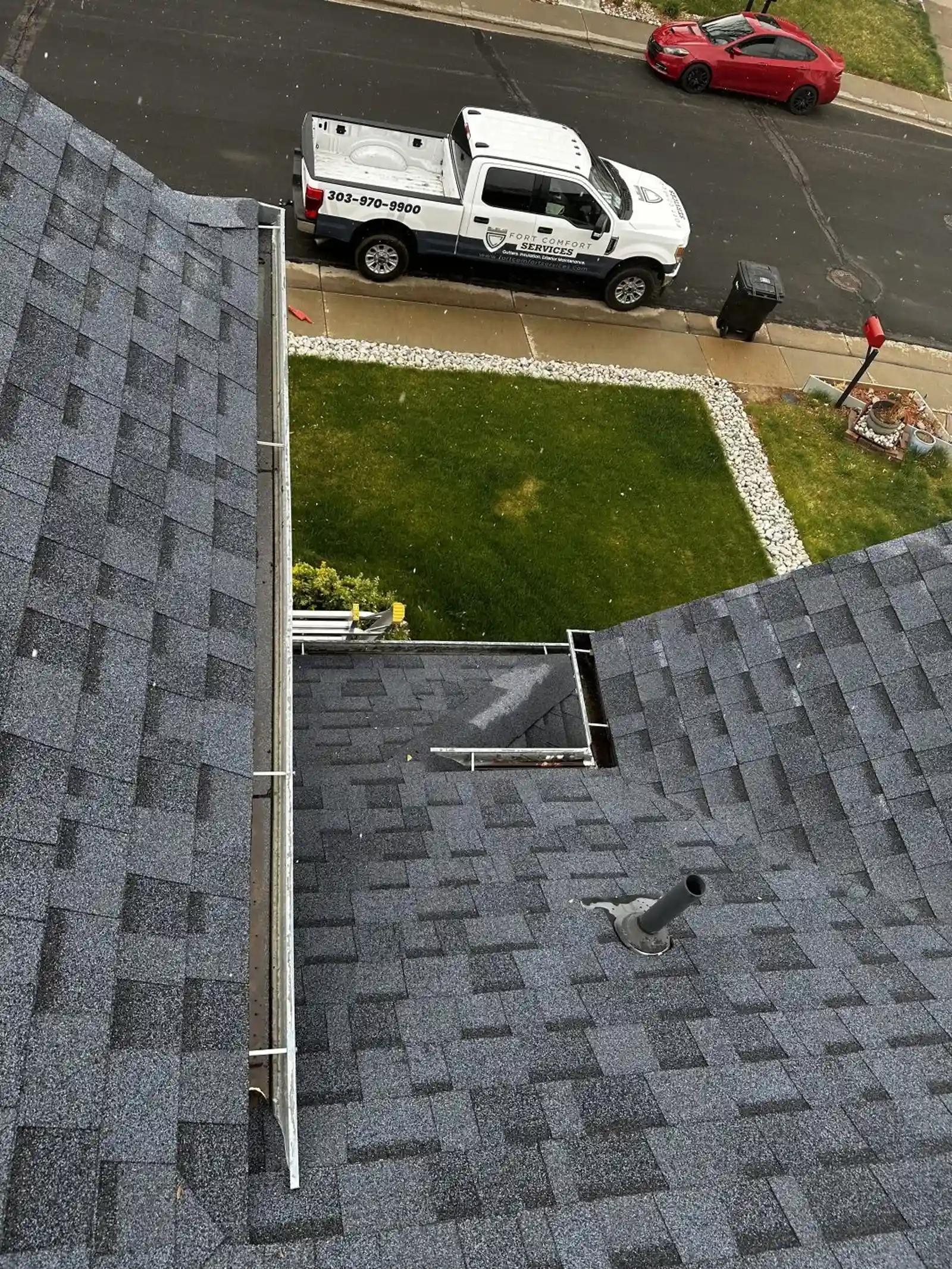
Most Boulder homeowners pay $200 to $350 for a professional gutter cleaning, set by the size and complexity of the home. Recurring plans lower the per-visit cost.
Same pricing as the rest of our service area — Boulder isn't charged a foothills premium on our gutter cleaning service. But what ends up in a Boulder gutter, and how often it needs clearing, is genuinely different from a home out on the eastern plains side of the metro. This guide covers why.
Boulder gutter cleaning prices by home size
A twice-a-year plan saves 10 percent per visit. Three times a year saves 20 percent.
Pricing is set by your home's size and complexity rather than by linear foot, so the number is fixed before we start. Some companies quote by the foot — commonly $0.70 to $2 — which leaves the total open until they arrive and measure. We'd rather you know the number when you book it.
Why Boulder gutters fill differently
Boulder sits against the Flatirons, and that position changes the debris equation in three ways that matter.
Conifers, not deciduous trees, drive the problem. Ponderosa pine and blue spruce dominate much of west Boulder, the canyon corridors, and the neighborhoods climbing toward the foothills. Needles are the hardest common gutter debris there is. They're fine enough to pass through basic screens, they don't rinse out, and they weave into a dense mat that catches everything landing on top of it. A needle-loaded gutter can look almost empty from the ground and still be running at a fraction of its capacity.
Wind loads the gutters with fine debris. Boulder's downslope winds are a defining feature of the local weather and they don't just move leaves around. They pack fine material — needles, grit, seed, dust — deep into the trough and into downspout elbows where it compacts. Fine debris driven in by wind behaves differently from debris that simply falls in. It settles tighter and takes more work to move.
The housing stock is older and more varied. Boulder has a substantial inventory of homes built well before 1980, many with gutter systems that are original, retrofitted, or some combination. Older systems have more brittle hangers, more separated seams, and more fascia that's been quietly weathering for decades. That's not a pricing issue so much as an inspection issue: on an older Boulder home, what the cleaning crew notices is often worth more than the cleaning. Catching a failing hanger or a soft board early turns a small gutter repair or soffit and fascia fix into the whole story, instead of a larger one two seasons later.
The wildfire consideration
This is the section most gutter cleaning articles skip entirely, and along the Front Range it may be the most important reason to keep a gutter clear.
Dry debris in a gutter is ignitable material sitting at your roofline. During a wind-driven fire, embers travel well ahead of the fire front and land on structures — and a trough packed with dry needles is one of the more reliable ways for an ember to find fuel on a home that's otherwise well defended.
Boulder County residents don't need this explained in the abstract. The December 2021 Marshall Fire moved through suburban neighborhoods during a high wind event, and it reframed how a lot of people here think about defensible space on an ordinary residential lot.
What that means practically:
- Keep gutters clear through fire season, not just on a seasonal schedule. Dry needles sitting in a gutter in August are a bigger hazard than wet debris in April. The calendar that matters for fire risk isn't the same one that matters for drainage.
- Metal beats plastic on ember-exposed properties. Plastic guards and vinyl components can soften, warp, or ignite. Stainless steel and aluminum don't.
- Fine mesh does double duty. A tightly woven metal mesh keeps needles out of the trough in the first place and reduces the path for embers to get in. On a pine-heavy property in or near the wildland-urban interface, that's the strongest argument for gutter guards there is.
- Coordinate it with the rest of your defensible space work. Gutters are part of Zone 0 — the first five feet around the structure — and they tend to be the part people forget while they're focused on vegetation.
If your insurer has asked about wildfire mitigation, keeping records of your gutter maintenance is worth doing.
Drainage: the other direction water causes problems
Boulder has a documented flood history and takes stormwater seriously for good reason. The September 2013 floods caused extensive damage across Boulder County, and the city maintains detailed floodplain mapping.
Gutters don't prevent flooding. What they control is where your own roof runoff goes, and a single home's roof sheds a substantial volume in a heavy rain. A blocked gutter delivers all of it straight down the wall to the foundation, at precisely the moment the surrounding ground is already saturated and can't take more.
Two things worth checking that have nothing to do with the cleaning itself:
Where your downspouts discharge. Extensions should carry water four to six feet clear of the foundation onto ground that slopes away. Downspouts that dump against the wall, or into a planting bed that holds water, are working against you.
Whether your grade still slopes away from the house. Soil settles. A grade that was correct when the house was built can be flat or reversed twenty years later, and nobody notices until water is showing up somewhere it shouldn't.
We flag both during a cleaning when we see a problem.
How often Boulder homes need it
Open lots with light tree cover — twice a year is fine. Late spring and after fall leaf drop.
Deciduous cover — twice a year, with the fall visit timed after full leaf drop rather than during it.
Pine and spruce cover — three times a year, minimum. Conifers shed continuously instead of in one window, so a two-visit schedule leaves the gutter loaded for months at a time. This describes a large share of Boulder proper and most of the foothills-adjacent neighborhoods.
Wildland-urban interface properties — three or more, with at least one visit timed ahead of peak fire season rather than purely by drainage logic.
After hail. A storm strips granules off your shingles and knocks loose debris down into the gutters. That grit is heavy and packs into a sludge at the bottom of the trough. A post-storm cleaning is the one most homeowners skip.
What a complete cleaning covers
- Hand removal of debris from the trough — not blown out
- Downspouts cleared and flushed with water, with flow confirmed at the outlet
- All debris bagged and hauled off
- Full inspection of hangers, seams, pitch, and fascia condition
- Photos and notes on anything found
On pine-heavy properties, the hand-removal point isn't a detail. Blowing needles out of a gutter with a leaf blower relocates the loose material onto the roof and into the landscaping and doesn't touch the compacted layer at the bottom, which is the part actually restricting flow. If a company's process is a leaf blower and a rinse, a needle-loaded Boulder gutter will not come out clean.
Signs your gutters need attention
From the ground, watch for water sheeting over the edge during rain, plants or seedlings growing in the trough, sagging or sections separating from the fascia, nesting activity along the roofline, and staining or mildew streaking down the siding.
In Boulder specifically, the earliest signal is usually slow drainage rather than visible overflow. Needle mats restrict flow long before they block it completely. If water takes longer to clear after a storm than it did last year, the system is already partly loaded.
DIY or hire it out
On a single-story home with good ladder footing, cleaning your own gutters is a manageable job if you're comfortable at height.
Boulder makes the calculation harder than average for two reasons. Hillside lots, mature landscaping, tight setbacks in older neighborhoods, and homes built into slopes all complicate ladder placement — and a ladder that can't be set on level ground is the ladder that slides. Second, needle removal by hand is slower and more tedious than scooping leaves, so the time cost of doing it properly yourself is higher than most people budget for.
The other half of the value is diagnostic. On homes with thirty-year-old gutter systems, the fastener and fascia problems that a trained eye catches during a routine cleaning are considerably cheaper to address than what they turn into.
Get Your Boulder Price in Minutes
Answer a few quick questions about your home and get an instant price. No visit needed.